
Invest in a Verified Homebuyer Drain Audit Today
Verified Basingstoke drain audits find hidden risks like roots or fatbergs missed by RICS surveys. They prevent £15k in repairs and empower price negotiations.
- 8 min read
Key Insights Summary
Verified homebuyer drain audits in Basingstoke are essential for uncovering subterranean structural failures, root ingress, and “fatberg” accumulations that standard RICS surveys miss. Using industry-leading hardware like Ridgid SeeSnake and Wincan VX reporting, our team provides forensic evidence of a property’s drainage health. In Basingstoke, areas such as main Road and those near the street or the other Distribution Road face unique risks from Victorian infrastructure and clay-rich soil. Failing to audit can result in repair costs exceeding £10,000. In contrast, verified results empower buyers to negotiate purchase prices and ensure long-term property resilience.

The Basingstoke Subsurface: Why Your Geography Determines Your Risk
Why do homebuyers need drain audit?

The most common question we hear is, “Doesn’t my standard home survey cover this?” The short answer is no. A standard RICS Level 2 or Level 3 survey is a visual inspection of accessible areas. If a surveyor lifts a manhole cover and sees water flowing, they tick a box. But they cannot see what is happening five meters down the line.
Over 50% of serious drainage faults—including longitudinal cracks, root infestations from mature oaks, or displaced joints—are completely invisible from the surface. Without a camera-led audit, your risk isn’t being measured; it’s being transferred to you the moment you exchange contracts.
Is Your Dream Home Built on a Sewer Time Bomb?
It sounds dramatic, but in the Basingstoke region, the “time bomb” is often a Grade 5 structural failure sitting quietly beneath a perfectly manicured garden. We recently handled a case near the Road corridor where the buyers were reassured by a general survey that found “no visible defects.” Our team was called in for a verified audit using a Ridgid SeeSnake system.
Within minutes, our HD camera revealed a massive root mass that had breached a joint in the 100-year-old clay pipework. The roots had acted as a filter, trapping fats and wet wipes, creating a blockage that was weeks away from a catastrophic backup. This discovery allowed the buyers to negotiate a £7,500 reduction in the purchase price to cover the necessary excavation. Without that audit, they would have had to pay for the dig three months after moving in.
Why is my bathroom smelling like rotten eggs in Basingstoke?
If you’ve visited a property and noticed a sulfurous “rotten egg” smell, don’t dismiss it as “just an old house smell.” This is typically hydrogen sulfide gas, a byproduct of the decomposition of organic matter. In Basingstoke’s dense urban center—especially near the historically appropriately known for drainage issues—these odors often signal a deeper issue.
The gas is produced by bacteria in stagnant water or trapped debris. It can enter the home if the “P-trap” (the U-shaped pipe under your sink) has dried out or if there is a breach in the soil vent pipe. In some conversions in the town center, we find that modern multi-occupancy has overloaded the original venting system, essentially “sucking” the water out of the traps and allowing sewer gas to flow freely into the living space.
The Science of Saponification and "Fatbergs"
The Soap-Making Process in Your Pipes
Saponification occurs when fats, oils, and grease (FOG) react with alkaline substances in the sewer. In Basingstoke, the primary source of these alkaline substances is calcium that leaches from concrete pipes or from lime mortar used in older brick sewers. When cooking oils go down the sink, they break down into free fatty acids. These acids then bond with the calcium ions in the water to form a solid, insoluble mass—essentially a hard, rock-like soap.
This mass creates a scaffold. Every time a “flushable” wet wipe (which, as we know, doesn’t actually disintegrate) or a piece of hair enters the system, it gets caught on this soap-like mass. Over the years, this builds into a fatberg that can be hundreds of meters long. Our verified audits use high-pressure water jetting from Whale Tankers to clear these masses before they cause structural damage to the pipe walls.
The Physics of Structural Resilience: CIPP Lining

When we find cracks or displaced joints, we don’t always have to dig. We often use Cured-In-Place Pipe (CIPP) lining. This technology involves inserting a resin-impregnated tube into the damaged pipe and “curing” it using heat or UV light.
From a technical standpoint, the success of a liner depends on its flexural modulus and flexural strength. The flexural modulus is a measure of the material’s stiffness—its ability to resist bending under the weight of the soil and groundwater. In the heavy clay soil of Basingstoke, the soil exerts significant “shrink-swell” pressure. A liner must be engineered to withstand these loads for at least 50 years. Our team utilizes advanced glass-fiber-reinforced liners that provide up to 12 times the strength of traditional felt liners, ensuring that your “pipe-within-a-pipe” is structurally independent of the failing host pipe.
Are You Inheriting a £15,000 Basingstoke Drainage Disaster?

How much will this cost me if I wait?
Waiting for a drain to fail is the most expensive decision a homeowner can make. In the UK, and specifically within the Basingstoke region, where labor and excavation costs are high, the numbers break down as follows:
- Standard Audit: £180 – £350. A one-time investment that provides a full Wincan-coded report.
- Collapsed Drain Replacement: £3,000 – £10,000. If a pipe collapses under your driveway or foundation, the excavation and reinstatement costs are astronomical.
- Subsidence Remediation: £10,000 – £20,000+. If a leaking drain washes out the clay soil beneath your home, it can lead to structural settlement.
- Insurance Denial: Most insurers will not cover “pre-existing” defects. If you don’t have a verified audit showing the drains were clear when you bought the house, they will likely argue the fault was there all along and reject your claim.
3 Signs a National Franchise is Overcharging You
When you search for “drain audit Basingstoke,” you’ll be met with big-budget ads from national franchises. While they have recognizable logos, they often use pricing models that don’t favor homebuyers. Here are three red flags our senior team recommends watching for:
- The Commission-Based Engineer: If the technician who does your survey also provides the repair quote and earns a commission on that repair, there is a clear conflict of interest. They are financially motivated to identify “critical” faults that might require only minor maintenance.
- Lack of Wincan Coding: A professional audit is more than just a video on a USB stick. It should be coded to industry standards (WRc MSCC5) using software like Wincan VX. If they provide a generic “technician’s opinion” instead of a coded condition report, you are paying for an amateur service at professional prices.
- The “Emergency” Upcharge for Standard Work: Many franchises treat a homebuyer audit as an “emergency call-out” and charge accordingly. A reputable Basingstoke specialist knows this is a planned, elective survey and should offer a fixed, competitive rate.
Is Your RICS Surveyor Hiding the Truth About Your Pipes?
They aren’t necessarily “hiding” it; they aren’t equipped to find it. An RICS surveyor is a generalist. They look at the roof, the damp-proof course, and the windows. When they reach the drains, their scope of work usually states that they will “lift accessible inspection covers and visually inspect the chambers.”
In many Basingstoke homes—especially those with extensions near the street or near the park—patios or conservatories have covered manholes. A general surveyor won’t use sonar tracing to find these hidden access points, nor will they have the Ridgid SeeSnake cameras required to navigate the bends of the system. Their report will often contain a generic disclaimer: “Drainage not fully inspected—further specialist investigation advised.” By the time you read that, you may already be deep into the buying process. A pre-emptive verified audit removes this ambiguity.
What is involved in a verified drain inspection for a home purchase?
A verified audit by our team is a forensic process. We don’t just “look” at pipes; we map them.
- Site Reconnaissance: We map all access points, using sonar if previous owners have buried them.
- CCTV System Sweep: We use Ridgid SeeSnake HD cameras for standard residential pipes and robotic ROVVER X crawlers for larger commercial runs.
- Structural Assessment: We identify every crack, displaced joint, and sign of wear.
- Connectivity Testing: In Basingstoke, misconnections are common. We ensure your waste is sent to the foul sewer, not into surface water drains that flow into local rivers.
- Standardized Reporting: We process all data through Wincan VX, producing reports accepted by mortgage lenders, insurers, and the local council.
Will Your New Home Sink into the Basingstoke Clay?
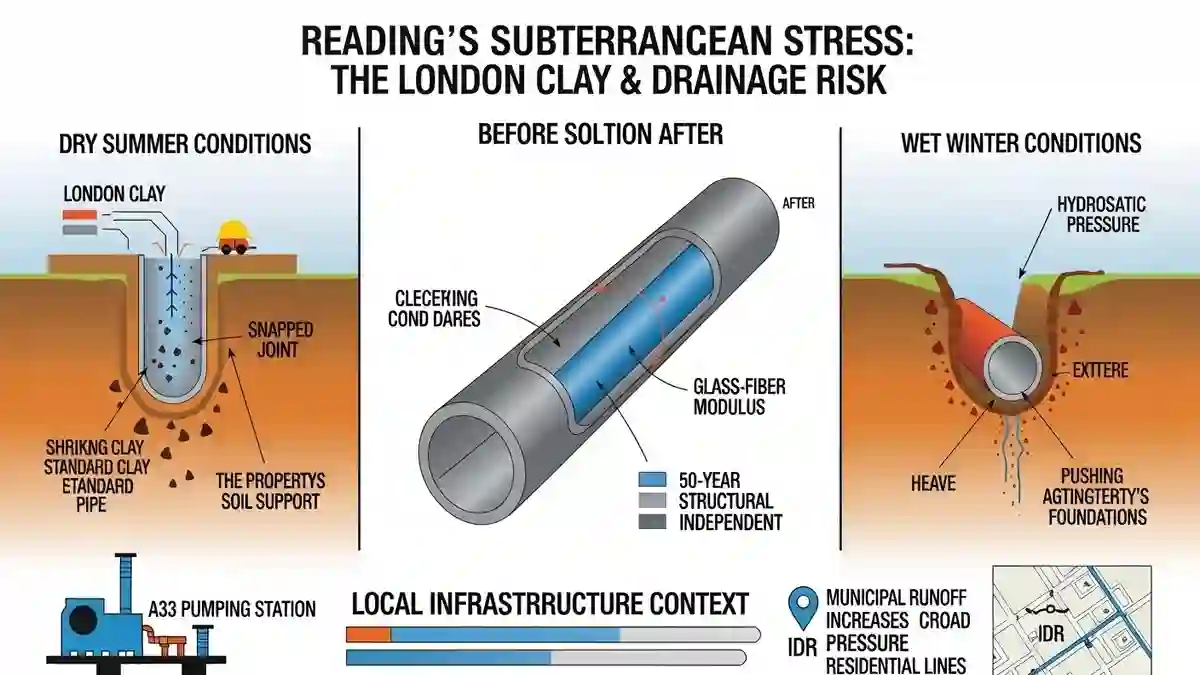
Basingstoke is notorious for its “London Clay” soil composition. This material is highly “shrink-swell” sensitive. During wet winters, it expands, putting immense pressure on foundations and pipes. During dry summers, it shrinks, creating voids that can cause pipes to snap.
Our audits pay special attention to the soil-pipe interaction. We look for “ground movement” indicators, such as pipes that have become “oval” under pressure. If a pipe is losing its circular shape, it’s a sign that the structural integrity is compromised. Without a verified audit, you might not realize your home is at risk of subsidence until the first cracks appear in your living room walls.
How to choose a reputable homebuyer drain auditor in Basingstoke?
Choosing the right consultant is about looking for three specific credentials:
- NADC Accreditation: The National Association of Drainage Contractors ensures that the firm meets strict technical and ethical standards.
- Wincan Proficiency: Ensure they use Wincan VX software for their reports. This ensures the data is “digitally twin-ready” for any future renovations you might plan.
- Equipment Quality: Ask whether they use industry-standard hardware, such as Ridgid or Milwaukee. High-definition footage is the only way to distinguish between a harmless stain and a structural crack.
What happens after a homebuyer drain audit finds issues?
If our audit uncovers problems, the sale doesn’t have to end. In fact, the audit becomes your most powerful negotiation tool.
- Renegotiation: You can present the Wincan report to the seller and request a price reduction equivalent to the repair quote. Most sellers in Basingstoke, faced with hard video evidence, will agree to a discount rather than risk the sale falling through.
- Seller Repair: You can request that the seller fix the issues before the exchange of contracts. If this happens, we recommend a follow-up “verification survey” to ensure the work was done to professional standards and not just a “quick fix” by an uncertified handyman.
- Peace of Mind: Even if the drains are perfect, you receive a map of your system. This is invaluable if you ever plan to extend your home, as the local council will require a “Build-Over Agreement” if you are building within three meters of a public sewer.
Conclusion: Don't Buy Blind in the Basingstoke Region
Basingstoke’s underground infrastructure is a hidden world of Victorian brickwork, modern plastic, and shifting clay. Buying a home without a verified drain audit is like buying a car without looking under the hood—only the engine is buried three meters underground and could cost you £15,000 to fix.
By investing in a professional survey today, you are protecting your future self from the stress, odors, and financial burden of drainage failure. Whether you are moving into a period home in the older part of town or a modern townhouse near the main road, let our team provide the clarity you need to move forward with confidence.
FAQs
Are neighbours liable for shared drainage repairs?
No. Since October 2011, the local water company typically assumed responsibility for any shared drains crossing property boundaries. Homeowners remain liable only for private sections serving their property within their boundary lines, reducing neighbourly repair cost disputes.
Can I build near public sewer lines?
Do mortgage lenders always require drain surveys?
No. While not mandatory for every purchase, approximately 15% of RICS surveys now require a mandatory drain inspection. Lenders often require verification if a surveyor notes slow flow, damp patches, or inaccessible manholes during the initial inspection.
Does drainage affect planning for residential conversions?
Are all drainage survey reports legally valid?
Talk to your local Basingstoke Drainage specialist
We are always happy to arrange a free site assessment and no obligation quotations for any work you might need. Alternatively, you can call our emergency hotline number on